Mastering Data Structures & Algorithms with 1,000 Curated Coding Challenges
Introduction: Programming Alone Is No Longer Enough
Imagine two students applying for the same Software Developer position.
Both know Java.
Both know Python.
Both have completed their university practicals.
Both have built academic projects.
Yet, when they appear for the coding assessment, one clears the technical round while the other gets eliminated within an hour.
The difference is rarely the programming language they know.
The difference lies in how they think.
Today’s technology companies are looking beyond syntax. They want engineers who can analyse problems, select the right data structures, design efficient algorithms, optimize execution time, and write clean, scalable code under pressure. This ability is what separates an average programmer from an industry-ready software professional.
That is why Data Structures and Algorithms (DSA) has become one of the most important technical skills for students aspiring to build careers in Software Development, Artificial Intelligence, Cloud Computing, Full Stack Development, Data Engineering, Cyber Security, and other emerging technology domains.
Recognising this changing landscape,Catalyst College has launched the CIMAGE DSA Practice Maha-abhiyan—a comprehensive academic initiative that integrates structured DSA practice into students’ regular classroom and laboratory learning.
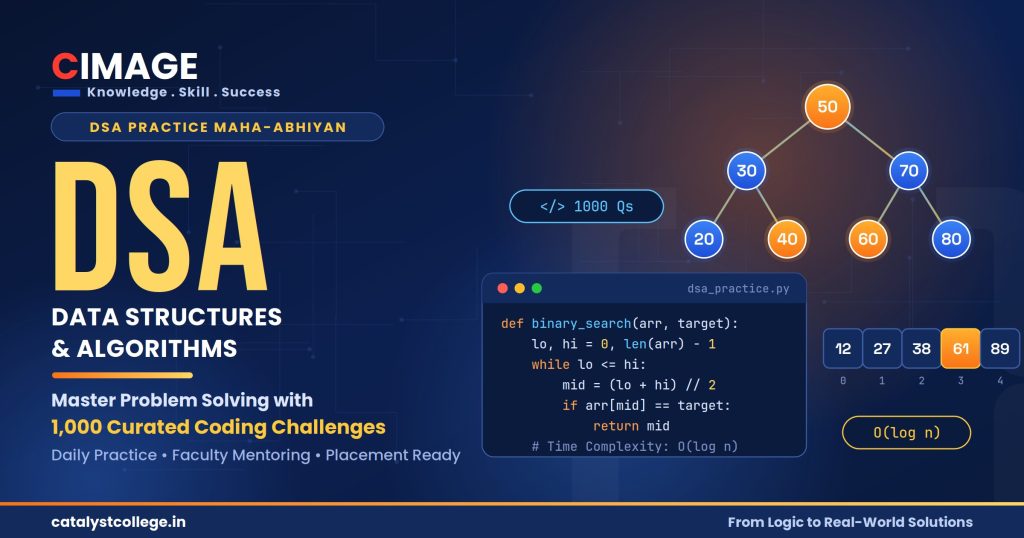
Rather than treating DSA as a placement-season topic, the initiative encourages students to build problem-solving skills every day through continuous practice, faculty mentoring, and progressive assessments. At the heart of this mission is a carefully curated repository of 1,000 coding questions designed to strengthen programming fundamentals, logical thinking, algorithmic understanding, and coding confidence.
The objective is not simply to help students clear coding interviews—it is to develop software professionals who can confidently solve real-world problems throughout their careers.
What is the CIMAGE DSA Practice Maha-abhiyan?
The CIMAGE DSA Practice Maha-abhiyan is a structured academic initiative that integrates Data Structures and Algorithms (DSA) practice into regular classroom teaching and computer laboratory sessions.
Unlike conventional DSA courses that are often conducted as short-term workshops or placement-focused crash programs, the Maha-abhiyan is designed as a continuous learning ecosystem where students practise coding throughout their academic journey.
Every participating student follows a structured learning pathway built around:
- Daily coding practice
- Topic-wise DSA learning
- Time-bound programming exercises
- Faculty-guided mentoring
- Continuous performance assessment
- Practical programming revision
- Progressive difficulty levels
- Regular feedback and improvement
The initiative is built upon a repository of 1,000 carefully selected DSA questions, organised to cover programming fundamentals, core data structures, advanced algorithms, and interview-oriented coding challenges.
Instead of memorising solutions, students learn how to analyse problems, compare multiple approaches, optimise algorithms, and develop efficient coding strategies.
This approach transforms coding from an examination subject into a practical skill that students strengthen every day.
Why Data Structures and Algorithms Matter in Today’s Technology Industry
The software industry has changed significantly over the last decade.
Modern applications process millions of transactions, analyse massive datasets, and serve users across the globe in real time. Whether it is a banking application, an e-commerce platform, a navigation system, or an AI-powered recommendation engine, every software product relies on efficient algorithms and well-designed data structures.
As a result, employers increasingly evaluate how candidates approach problems—not just whether they can write code.
During technical recruitment, students are commonly expected to:
- Analyse complex programming problems
- Choose appropriate data structures
- Design efficient algorithms
- Optimise execution time
- Reduce memory consumption
- Debug and improve existing code
- Explain the logic behind their solutions
These abilities form the foundation of Data Structures and Algorithms.
A strong understanding of DSA enables students to write software that is not only correct but also efficient, scalable, and maintainable.
More importantly, DSA develops analytical thinking—a skill that remains valuable throughout a technology professional’s career, regardless of the programming language or framework they use.
Why CIMAGE Started the DSA Practice Maha-abhiyan
Technology is evolving faster than ever before.
Artificial Intelligence, Cloud Computing, Automation, Data Engineering, Cyber Security, and Enterprise Software Development have transformed the expectations placed on software professionals.
Companies are no longer hiring candidates solely because they know a programming language. They seek graduates who can solve problems systematically, think computationally, and adapt to new technologies with confidence.
Recognising this shift, CIMAGE identified a common challenge faced by many students.
While students successfully completed academic practicals and programming assignments, many lacked the habit of solving algorithmic problems consistently. Coding became an activity reserved for examinations or placement season rather than a daily discipline.
The CIMAGE DSA Practice Maha-abhiyan has been introduced to bridge this gap.
Its vision is to create a campus-wide culture where coding becomes a regular academic practice rather than a last-minute preparation strategy.
Instead of learning concepts once and revisiting them months later, students continuously reinforce their understanding through structured problem solving, practical implementation, revision, and faculty feedback.
By integrating DSA into everyday classroom and laboratory sessions, the initiative aims to strengthen not only technical competence but also confidence, discipline, consistency, and analytical thinking.
From Programming Knowledge to Problem-Solving Excellence
Many students believe that learning Java, Python, C++, or JavaScript is enough to build a successful software career.
In reality, programming languages are tools.
The real value lies in understanding how to use those tools to solve problems efficiently.
The CIMAGE DSA Practice Maha-abhiyan focuses on developing this transition.
Students gradually move from writing simple programs to solving increasingly complex algorithmic challenges.
Instead of asking:
“Which programming language should I learn?”
the initiative encourages students to ask:
- What is the most efficient solution?
- Can this algorithm run faster?
- Can memory usage be reduced?
- Is there a better data structure?
- Can the logic be simplified?
These are the kinds of questions software engineers ask every day while building real-world applications.
By cultivating this mindset early, students become better prepared not only for technical interviews but also for long-term success in the software industry.
A Mission to Build Industry-Ready Professionals
The CIMAGE DSA Practice Maha-abhiyan is more than a coding initiative—it is an academic mission that reflects the institution’s commitment to industry-oriented education.
By combining structured practice, progressive learning, experienced faculty mentorship, and continuous assessment, the initiative seeks to transform programming into a habit and problem-solving into a core professional competency.
In the next section, we will explore the 1,000 Curated DSA Questions Framework, the complete curriculum covered under the initiative, and how daily coding practice is structured to help students steadily progress from programming fundamentals to interview-level algorithmic problem solving.
The 1,000 Curated DSA Questions Framework: A Structured Roadmap to Coding Excellence
One of the defining strengths of the CIMAGE DSA Practice Maha-abhiyan is its carefully designed 1,000-question practice framework.
Instead of asking students to solve random coding problems from multiple websites, the initiative provides a structured roadmap that gradually develops programming ability, logical thinking, algorithmic understanding, and optimization skills.
The question bank has been curated by experienced faculty members to align with academic learning, practical programming, and the problem-solving competencies expected in modern software careers.
Every question has a purpose.
Students do not simply solve problems—they progress through increasingly challenging concepts that reinforce classroom learning while preparing them for technical interviews and professional software development.
Why a Structured Question Bank Matters
Many students begin learning DSA by solving random questions from coding platforms.
Although this approach may appear productive, it often creates significant gaps in conceptual understanding.
Students frequently skip fundamental concepts, attempt advanced problems too early, or repeatedly solve similar questions while overlooking important topics.
The CIMAGE DSA Practice Maha-abhiyan eliminates this problem through a carefully sequenced learning framework.
Each topic builds upon the previous one, ensuring that students first develop conceptual clarity before progressing towards advanced algorithmic challenges.
Rather than focusing on quantity alone, the initiative emphasises systematic learning, continuous revision, and progressive improvement.
Complete DSA Curriculum Covered Under the Maha-abhiyan
The 1,000-question repository has been carefully designed to cover the complete spectrum of Data Structures and Algorithms (DSA) required for academic excellence, technical interviews, competitive coding, and modern software development. The curriculum follows a structured learning path, enabling students to progress from programming fundamentals to advanced algorithmic problem-solving through continuous practice and faculty guidance.
Programming Fundamentals
Builds a strong foundation in programming by strengthening logical thinking, code structuring, and problem-solving abilities. Students begin with variables, data types, operators, control statements, loops, functions, modular programming, input-output handling, debugging techniques, and code readability. A solid understanding of these concepts enables students to write clean, maintainable programs and confidently implement advanced data structures and algorithms.
Arrays
Develops logical thinking and efficient data manipulation techniques used extensively in software development. Students practise array traversal, insertion, deletion, rotation, prefix sums, sliding window techniques, two-pointer approaches, and optimisation-based problem solving. Strong array concepts help students solve many coding interview problems quickly and efficiently.
Strings
Strengthens text processing and pattern-based problem-solving skills commonly required in real-world applications. Students learn string manipulation, substring operations, palindrome detection, frequency analysis, character mapping, pattern matching, and string optimisation techniques. These concepts are widely used in search engines, text editors, data processing, and technical interviews.
Searching Techniques
Introduces efficient methods for locating data while improving algorithmic thinking and program performance. Students learn linear search, binary search, lower and upper bounds, search optimisation, and search-based problem-solving strategies. Understanding these techniques helps in selecting the most efficient approach for different programming scenarios.
Sorting Algorithms
Builds the ability to organise data efficiently while understanding algorithm performance and optimisation. Students practise Bubble Sort, Selection Sort, Insertion Sort, Merge Sort, Quick Sort, Heap Sort, and Counting Sort, while comparing their time and space complexities. Sorting forms the foundation of numerous software applications and coding assessments.
Linked Lists
Develops an understanding of dynamic memory management and flexible data organisation. Students explore singly linked lists, doubly linked lists, circular linked lists, insertion, deletion, reversal, merging, and cycle detection. These concepts improve problem-solving skills for applications where dynamic data storage is essential.
Stack and Queue
Strengthens problem-solving skills through sequential data processing techniques widely used in software systems. Students implement stacks and queues to solve expression evaluation, parenthesis balancing, recursion simulation, scheduling, breadth-first search, and sliding window problems. These data structures are fundamental to operating systems, compilers, and application development.
Hashing
Introduces fast data retrieval techniques that significantly improve algorithm efficiency. Students practise frequency counting, duplicate detection, hash maps, hash sets, collision handling, and lookup optimisation. Hashing is one of the most frequently used techniques in modern software development for achieving high-performance solutions.
Recursion
Enhances computational thinking by teaching students how to solve complex problems through smaller, repetitive sub-problems. Students learn recursive functions, recursive tree traversal, divide-and-conquer techniques, and recursion optimisation. This concept lays the groundwork for advanced algorithms such as Dynamic Programming and Backtracking.
Trees
Develops hierarchical problem-solving skills essential for advanced software engineering. Students learn binary trees, tree traversals, height calculation, diameter problems, Lowest Common Ancestor (LCA), tree construction, and recursive tree algorithms. Tree-based concepts are widely applied in databases, file systems, compilers, and search engines.
Binary Search Trees (BST)
Builds efficient searching and ordered data management skills. Students implement insertion, deletion, searching, balancing concepts, predecessor-successor operations, and traversal techniques. BSTs demonstrate how organised data structures can dramatically improve software performance.
Heap
Introduces priority-based data management and optimisation techniques. Students learn min-heaps, max-heaps, heap construction, heap sort, priority queues, kth-largest element problems, and median-based algorithms. Heap data structures are commonly used in scheduling systems, resource allocation, and graph algorithms.
Trie
Strengthens efficient string searching and prefix-based data retrieval techniques. Students implement trie data structures for autocomplete systems, dictionary applications, spell checking, and prefix matching. These concepts are widely used in search engines and intelligent text-processing systems.
Graph Algorithms
Develops advanced analytical and network-based problem-solving skills. Students learn graph representation, Breadth-First Search (BFS), Depth-First Search (DFS), shortest path algorithms, topological sorting, minimum spanning trees, connected components, and cycle detection. Graph algorithms are fundamental to navigation systems, networking, artificial intelligence, and recommendation engines.
Dynamic Programming
Builds the ability to solve highly complex optimisation problems efficiently. Students practise memoization, tabulation, state transitions, knapsack problems, longest common subsequence, matrix DP, and interval DP. Dynamic Programming enables programmers to transform computationally expensive solutions into highly efficient algorithms.
Greedy Algorithms
Develops decision-making skills for solving optimisation problems through locally optimal choices. Students solve activity selection, interval scheduling, Huffman coding, job sequencing, and minimum platform problems while learning when greedy strategies produce globally optimal solutions.
Backtracking
Strengthens logical reasoning and systematic exploration of multiple solution paths. Students solve N-Queens, Sudoku, maze traversal, subset generation, combinations, and permutation-based problems. Backtracking significantly improves analytical thinking and prepares students for challenging technical interviews.
Advanced Algorithmic Problems
Integrates multiple DSA concepts to solve complex real-world programming challenges. Students apply combinations of arrays, trees, graphs, dynamic programming, hashing, and recursion to build efficient, scalable solutions while developing confidence in tackling unfamiliar problems.
Interview-Level Coding Challenges
Prepares students for technical recruitment through structured, time-bound coding assessments. Students solve mixed-topic algorithmic problems under realistic interview conditions, focusing on accuracy, optimisation, debugging, code quality, and effective time management. This final stage helps students build the confidence required for coding assessments and technical interviews conducted by leading technology companies.
Daily Coding Practice Methodology
One of the key strengths of the CIMAGE DSA Practice Maha-abhiyan is its structured daily learning methodology. Rather than treating coding as an occasional activity before examinations or placement drives, the initiative encourages students to make problem-solving a regular academic habit.
Each practice session follows a carefully designed learning cycle that combines concept building, guided implementation, independent coding, performance analysis, and continuous improvement.
Concept Building
Every session begins with a focused discussion on the day’s topic, where faculty members explain the underlying concepts, algorithmic approach, and practical applications through classroom discussions and demonstrations. This ensures students understand why a particular data structure or algorithm is used before attempting coding problems.
Guided Programming Practice
After developing conceptual clarity, students implement fundamental programs under faculty guidance. This stage helps bridge the gap between theory and practical implementation while reinforcing programming fundamentals and coding best practices.
Time-Bound Coding Challenges
Students then solve carefully curated coding problems within predefined time limits. Practising under timed conditions improves coding speed, logical decision-making, and confidence while preparing students for technical assessments and competitive programming environments.
Code Review and Accuracy Assessment
Faculty members evaluate each solution based on multiple parameters, including program correctness, logical structure, code readability, optimisation, and debugging approach. The emphasis is on writing efficient and maintainable code rather than simply producing the correct output.
Algorithm Optimisation
Students compare different approaches to solving the same problem and learn how improvements in algorithm design can significantly reduce execution time and memory consumption. This stage develops analytical thinking and introduces students to the importance of time and space complexity.
Continuous Performance Monitoring
Individual progress is tracked regularly by evaluating coding speed, accuracy, conceptual understanding, debugging skills, and overall problem-solving ability. Faculty members provide constructive feedback that helps students identify strengths as well as areas requiring additional practice.
Revision and Reinforcement
Important concepts are revisited periodically through revision sessions and additional coding exercises. This continuous reinforcement strengthens long-term retention and gradually builds confidence in solving increasingly complex programming challenges.
A Continuous Cycle of Learning and Improvement
The CIMAGE DSA Practice Maha-abhiyan follows a simple yet highly effective learning cycle:
Learn → Understand → Implement → Practise → Analyse → Optimise → Improve → Repeat
By following this structured methodology every day, students gradually develop the discipline, consistency, and analytical mindset required to become confident programmers and industry-ready software professionals.
Time + Accuracy = Placement Readiness
Success in coding assessments depends on two equally important factors:
- Writing correct solutions
- Writing them within the available time
The CIMAGE DSA Practice Maha-abhiyan therefore trains students to balance both.
Rather than focusing solely on completing questions, students learn to write clean, efficient, and optimised code while managing time effectively. Regular practice under realistic conditions develops confidence, improves debugging skills, and strengthens decision-making during technical assessments.
Over time, this disciplined approach helps students transition from solving individual programming exercises to confidently tackling interview-level coding challenges—a skill that forms the foundation of successful careers in software development and other technology domains.
Preparing Students for Modern Technology Careers Through DSA
In today’s technology-driven world, programming knowledge alone is no longer sufficient to build a successful career. Organizations across industries seek professionals who can analyse problems, design efficient solutions, optimise algorithms, and develop scalable software applications.
The CIMAGE DSA Practice Maha-abhiyan has been designed with this objective in mind. Through continuous coding practice, structured learning, and faculty mentoring, the initiative prepares students for the analytical and problem-solving skills required across diverse technology domains.
Rather than limiting students to one specific career path, a strong foundation in Data Structures and Algorithms opens opportunities across software engineering, cloud technologies, artificial intelligence, data science, cybersecurity, enterprise applications, and many other emerging fields.
Career Opportunities Supported by Strong DSA Skills
Software Development
A strong understanding of DSA enables students to design efficient software solutions, optimise application performance, and solve complex programming challenges. These skills form the backbone of careers in Software Development, Backend Engineering, Full Stack Development, Web Development, and Mobile App Development.
Artificial Intelligence & Machine Learning
Artificial Intelligence applications rely heavily on efficient algorithms, data processing, optimisation techniques, and computational thinking. Strong DSA knowledge helps students understand algorithm design, data organisation, and performance optimisation while building intelligent systems.
Data Engineering & Big Data
Modern businesses generate enormous volumes of data every day. Efficient storage, retrieval, processing, and analysis of this information require strong algorithmic thinking. DSA provides the foundation for careers in Data Engineering, Big Data Technologies, Database Management, and Business Analytics.
Cloud Computing & DevOps
Cloud-native applications demand scalable architectures and efficient resource management. Understanding algorithms, memory optimisation, scheduling techniques, and efficient data processing enables students to build reliable cloud-based applications and infrastructure.
Cyber Security
Cyber Security professionals frequently work with encryption techniques, network analysis, secure data processing, graph algorithms, and optimisation problems. Strong analytical thinking developed through DSA contributes significantly to designing secure software systems and identifying vulnerabilities.
Enterprise Software & Product Engineering
Large-scale enterprise applications process millions of transactions every day. Efficient algorithms, optimised databases, and scalable software architectures are essential for maintaining high performance. DSA prepares students to contribute effectively to enterprise software development and product engineering teams.
Technical Consulting & Digital Transformation
Consulting organisations require professionals who can analyse business problems and design technology-driven solutions. Logical reasoning, structured thinking, and optimisation skills gained through DSA help students build successful careers in Technical Consulting, Digital Transformation, and Solution Architecture.
Industry-Oriented Coding Preparation
Technical recruitment processes have evolved significantly over the years. Organizations increasingly evaluate a candidate’s ability to analyse problems, design efficient algorithms, and write optimised code rather than testing only programming syntax.
Keeping this industry trend in mind, the CIMAGE DSA Practice Maha-abhiyan incorporates coding practice that develops competencies commonly assessed during recruitment processes across leading product companies, Global Capability Centres (GCCs), consulting organisations, and IT services companies.
The structured practice framework helps students strengthen the problem-solving abilities expected in technical hiring processes conducted by organizations such as Microsoft, Google, Meta, Amazon, Oracle, IBM, Intel, Accenture, Cognizant, Capgemini, LTIMindtree, NTT DATA, Persistent Systems, Amdocs, PwC, EY, Deloitte, KPMG, and many other leading technology employers.
Rather than preparing students for one specific company, the initiative focuses on building universal programming and analytical skills that remain valuable throughout their professional careers.
Faculty-Led Mentoring: Learning Beyond Self-Practice
One of the distinguishing features of the CIMAGE DSA Practice Maha-abhiyan is its strong faculty mentoring model.
While coding platforms provide access to thousands of programming problems, many students struggle because they lack structured guidance, timely feedback, and concept clarification. The Maha-abhiyan addresses this challenge through continuous mentoring by experienced faculty members and practical programming coordinators.
The initiative is led by Dr. Amit Shukla, who provides academic direction and oversees the overall implementation of the programme.
The learning process is further strengthened by dedicated faculty coordinators responsible for different programming domains:
- Ravi Soni – Computing
- Raju Upadhyay – Java
- Niraj Kr. Singh – Web Technologies
- Sonam Ma’am – Organising Team & Academic Coordination
In addition, Practical Programming Coordinators and Computer Laboratory Mentors actively support students during coding sessions by providing personalised guidance, resolving programming challenges, reviewing solutions, and encouraging continuous improvement.
This collaborative mentoring ecosystem ensures that students receive consistent academic support throughout their learning journey.
Continuous Performance Assessment
Learning becomes more effective when progress is measured consistently.
The CIMAGE DSA Practice Maha-abhiyan therefore follows a continuous assessment model that enables both students and faculty members to monitor improvement over time.
Instead of evaluating students only during semester examinations, performance is reviewed regularly through coding practice sessions, classroom activities, laboratory exercises, and periodic assessments.
Students receive feedback on multiple performance parameters, including:
- Programming Accuracy
- Coding Speed
- Logical Thinking
- Algorithm Design
- Code Optimisation
- Debugging Skills
- Problem-Solving Ability
- Conceptual Understanding
- Consistency in Practice
- Overall Progress
This continuous evaluation helps students identify their strengths, recognise areas requiring additional attention, and develop a disciplined approach towards learning programming.
Benefits of the CIMAGE DSA Practice Maha-abhiyan
The initiative has been designed to create long-term academic and professional value for students.
Academic Benefits
- Strengthens programming fundamentals
- Improves conceptual clarity in Data Structures and Algorithms
- Reinforces classroom learning through continuous practice
- Enhances logical and analytical thinking
- Develops systematic problem-solving abilities
Placement Benefits
- Builds confidence for coding assessments
- Improves technical interview performance
- Enhances coding speed and accuracy
- Develops algorithm optimisation skills
- Encourages consistent placement-oriented preparation
Professional Benefits
- Prepares students for modern software development practices
- Strengthens computational thinking
- Improves code quality and maintainability
- Develops scalable solution design capabilities
- Builds industry-relevant technical competencies
Personal Development
Beyond technical skills, the initiative also nurtures discipline, consistency, patience, perseverance, and confidence. By solving progressively challenging problems every day, students learn to approach complex situations with a structured and analytical mindset—qualities that contribute not only to professional success but also to lifelong learning.
Building a Culture of Continuous Learning
The true objective of the CIMAGE DSA Practice Maha-abhiyan extends beyond improving placement readiness. It aims to create a campus-wide culture where coding becomes a daily academic discipline rather than a short-term activity before examinations or recruitment drives.
Through structured learning, regular practice, expert faculty mentorship, and continuous performance assessment, the initiative empowers students to become confident programmers, analytical thinkers, and industry-ready technology professionals capable of solving real-world challenges with efficiency and innovation.
Frequently Asked Questions (FAQs)
1. What is the CIMAGE DSA Practice Maha-abhiyan?
The CIMAGE DSA Practice Maha-abhiyan is a structured academic initiative designed to help students master Data Structures and Algorithms (DSA) through daily coding practice, faculty mentoring, and a carefully curated repository of 1,000 programming questions. The programme integrates coding practice into regular classroom and laboratory sessions, enabling students to build strong programming, analytical, and problem-solving skills.
2. Why is Data Structures and Algorithms (DSA) important?
Data Structures and Algorithms form the foundation of efficient software development. A strong understanding of DSA helps programmers design scalable applications, optimise program performance, solve complex computational problems, and perform well in technical interviews and coding assessments conducted by leading technology companies.
3. Who can participate in the DSA Practice Maha-abhiyan?
The initiative is designed primarily for students pursuing technology-focused programmes at CIMAGE, including BCA, B.Tech, MCA, B.Sc.-IT, and other programming-oriented courses where algorithmic thinking and software development skills are essential.
4. Is prior programming experience required?
Students are introduced to concepts in a structured and progressive manner. The programme begins with programming fundamentals before gradually advancing towards complex data structures, algorithms, and interview-level coding challenges.
5. How many coding questions are included in the programme?
The CIMAGE DSA Practice Maha-abhiyan is built around a carefully curated repository of approximately 1,000 coding questions, organised topic-wise and difficulty-wise to ensure systematic learning and continuous improvement.
6. Which Data Structures and Algorithms topics are covered?
The curriculum includes Programming Fundamentals, Arrays, Strings, Searching, Sorting, Linked Lists, Stack, Queue, Hashing, Recursion, Trees, Binary Search Trees, Heap, Trie, Graph Algorithms, Dynamic Programming, Greedy Algorithms, Backtracking, Advanced Algorithmic Problems, and Interview-Level Coding Challenges.
7. How does daily coding practice improve programming skills?
Regular coding practice strengthens logical thinking, improves programming speed, enhances debugging skills, reinforces conceptual understanding, and develops confidence in solving increasingly complex programming problems. Continuous practice also helps students retain concepts more effectively than occasional preparation before examinations or placements.
8. How are students evaluated during the programme?
Student performance is assessed continuously through classroom coding sessions, laboratory practice, faculty observations, programming assignments, and periodic assessments. Evaluation focuses on programming accuracy, coding speed, algorithm design, optimisation, debugging ability, conceptual clarity, and overall consistency.
9. How does the DSA Practice Maha-abhiyan help with placements?
The programme develops the analytical thinking and coding skills commonly assessed during technical recruitment processes. By strengthening problem-solving ability, algorithm optimisation, and programming confidence, students become better prepared for coding assessments, technical interviews, and software development roles across various industries.
10. Who mentors students during the programme?
The initiative is led by Dr. Amit Shukla, supported by Ravi Soni (Computing), Raju Upadhyay (Java), Niraj Kr. Singh (Web Technologies), Sonam Ma’am (Organising Team & Academic Coordination), along with Practical Programming Coordinators and Computer Laboratory Mentors who provide continuous academic guidance.
11. Does the programme focus only on placements?
No. While placement readiness is one of its important objectives, the primary goal is to develop strong programming fundamentals, logical reasoning, computational thinking, and professional software development skills that remain valuable throughout a student’s career.
12. What makes the CIMAGE DSA Practice Maha-abhiyan different?
Unlike short-term DSA courses or placement crash programmes, the CIMAGE DSA Practice Maha-abhiyan integrates structured coding practice into everyday academic learning. Students benefit from a systematic curriculum, daily problem-solving, continuous faculty mentoring, regular assessments, and long-term skill development rather than last-minute preparation.
Conclusion
Technology continues to reshape industries, creating new opportunities for professionals who possess not only programming knowledge but also the ability to think logically, solve complex problems, and develop efficient software solutions.
The CIMAGE DSA Practice Maha-abhiyan represents CIMAGE Group of Institutions’ commitment to preparing students for this evolving technology landscape. By integrating structured DSA learning into regular academics, the initiative transforms coding from an examination subject into a disciplined daily practice.
Through a carefully curated 1,000-question framework, expert faculty mentoring, continuous performance assessment, and systematic problem-solving, students progressively build the confidence, analytical thinking, and technical expertise required for successful careers in software engineering and emerging technology domains.
The vision of the Maha-abhiyan extends far beyond placements. It aims to nurture a generation of programmers who approach challenges with logic, creativity, and confidence, becoming professionals capable of contributing meaningfully to the rapidly evolving digital economy.
At CIMAGE, the goal is simple yet ambitious—to transform learners into industry-ready professionals through consistent practice, continuous improvement, and excellence in problem solving.